
menu
menu

In this article

Board self-assessments have evolved from shareholder transparency requirements to fundamental governance necessities, with 99% of S&P 500 boards conducting annual performance evaluations in 2024, according to Spencer Stuart’s Board Index. Yet nearly a third of governance leaders in the APAC region say director evaluations need a complete overhaul, according to the APAC Governance Outlook 2026 by Diligent Institute, Governance Institute of Australia and Singapore Institute of Directors. That gap signals that adoption alone does not guarantee effectiveness.
The challenge is conducting meaningful assessments that respect directors’ time while delivering value. Directors already face time pressures managing their governance responsibilities, making streamlined evaluation tools essential.
This guide covers practical strategies for improving your board self evaluation process:
A board self evaluation is a structured process through which the board, its committees and sometimes individual directors assess their own effectiveness, composition, processes and information flows.
The evaluation typically uses questionnaires, interviews or facilitated discussions to surface strengths, gaps and improvement priorities. It can also incorporate CEO and management feedback, external facilitation or peer benchmarking to add perspective beyond the boardroom.
Effective evaluations examine several core governance dimensions. Board composition and skills, including whether the current mix of expertise matches organizational strategy, should be assessed alongside strategy and risk oversight, which increasingly includes cyber, AI and climate considerations.
Board culture and dynamics, meeting quality and information flow, committee effectiveness and leadership performance round out a thorough assessment. Covering each of these areas gives boards a complete picture of where they excel and where targeted improvements will have the greatest impact.
Evaluations generally fall into three categories: full board evaluations that assess collective effectiveness, committee evaluations that review oversight responsibilities for groups like the audit or compensation committee and individual director and chair evaluations that examine personal contributions and leadership.
Running all three consistently with reusable questionnaire templates and integrated analytics creates a longitudinal view of governance performance that improves with each cycle. If you're refining how each evaluation type runs in practice, this guide to sample board evaluation questionnaire questions offers 28 example prompts and implementation guidance you can adapt.
Public company board self-assessments became widespread following shareholder demands for transparency and accountability during the early 2000s governance reforms.
While NYSE and NASDAQ listing standards require annual self-assessments for most public boards, the specific disclosure requirements vary by sector and jurisdiction. Not all boards must make detailed findings public.
Current regulatory emphasis focuses on conducting systematic evaluations rather than mandating public disclosure of results. This shift allows boards to use assessments for improvement rather than primarily for compliance demonstration.
Growing companies, public issuers and nonprofits alike benefit from establishing evaluation disciplines early, creating governance foundations that support scaling operations and investor confidence throughout organizational development.
Systematic evaluations help identify skill gaps, process improvements and director development needs before they become critical operational challenges during funding rounds or transaction preparation.
Board evaluations are usually complex, but they’re also incredibly valuable. Below are 15 board evaluation best practices that every organization should consider.
Establish measurable objectives aligned with organizational strategy rather than generic effectiveness reviews. Focus on specific challenges like transaction readiness, risk oversight capability, or stakeholder communication excellence. Document these objectives and use them across evaluation cycles to ensure focus while adapting to emerging governance priorities.
Determine evaluation scope, methodology and reporting frameworks before launching assessments. Create clear timelines, assign responsibilities and establish completion tracking mechanisms. Ensure systematic assessment across the full board, individual directors and committee evaluations with methodologies that eliminate coordination complexity. For a more granular walkthrough, you can map your approach to this eight-step board evaluation process, which spells out the sequence from scoping and survey design through facilitation, analysis and follow-up.
Board evaluations should encourage honest feedback by ensuring that results will remain anonymous. Manual processes and generic online survey tools often rely on personal or company email addresses and basic access controls, which can undermine directors' confidence in true anonymity. Working with an outside facilitator or a purpose-built board questionnaire tool helps preserve confidentiality.
“The ways that boards establish norms intentionally is by having a third-party interview directors and adding on a couple of questions about how they experience the board. Questions like, ‘What do you like about the board? What do you wish? What do you wonder?’
When you ask questions like, ‘What don’t you like about the meeting?’ it narrows people’s thinking. But when you ask, ‘What do you wish? What do you like? What do you wonder?’ you start curating what works well,” says Lori Nishiura Mackenzie, Co-Founder of the Stanford VMware Women’s Leadership Innovation Lab.
Board evaluations must protect privileged communications through appropriate security measures. Implement data protection protocols, secure transmission methods and access controls that meet organizational standards. For multinational operations, ensure compliance with relevant data residency and privacy requirements.
Evaluation processes should respect directors’ time constraints. Effective board engagement requires making participation as seamless as possible for busy directors.
“Board engagement, to me, comes down to two pillars: relationship building and setting your board members up for success. It’s about helping them get what they need and making it easy for them to connect with the mission of your organization,” says April Van Epps, Chief of Staff at Centerstone.
This principle applies directly to evaluations. Setting directors up for success means designing assessments they can complete flexibly, during travel or between meetings, maximizing participation while minimizing administrative burden. When evaluations are user-friendly and respect time constraints, directors are more likely to provide thoughtful feedback.
Evaluation processes should respect directors' time constraints. Effective board engagement requires making participation as seamless as possible for busy directors.
"Board engagement, to me, comes down to two pillars: relationship building and setting your board members up for success. It's about helping them get what they need and making it easy for them to connect with the mission of your organization," says April Van Epps, Chief of Staff at Centerstone.
This principle applies directly to evaluations. Setting directors up for success means designing assessments they can complete flexibly, during travel or between meetings, maximizing participation while minimizing administrative burden. When evaluations are user-friendly and respect time constraints, directors are more likely to provide thoughtful feedback. Pairing evaluations with disciplined meeting prep reinforces the same principle; our board meeting preparation checklist gives directors a simple framework for reviewing materials, clarifying priorities and arriving ready to contribute.
Board directors will look more favorably on completing board assessments when they can use a tool that integrates with existing board management and governance software. They’ll also be more receptive to the ability to complete the evaluations on their mobile device.
Standardized frameworks enable meaningful year-over-year comparisons and progress tracking. Maintain evaluation questions and response categories from previous cycles while adapting to emerging governance priorities, ensuring historical context preservation and trend analysis across multiple assessment periods.
Manual processes are time-consuming and error-prone. Board secretaries often spend weeks manually compiling evaluation responses, creating summary reports and coordinating follow-up discussions. These time-intensive activities divert resources from strategic governance work.
Automate data compilation and report generation wherever possible, reducing preparation time from days to hours. Specialized board assessment platforms can aggregate responses, identify common themes and generate standardized reports that highlight key findings, going far beyond what general-purpose survey tools can provide.
Focus automation efforts on repetitive tasks like data entry, response tabulation and basic analytics while preserving human judgment for interpretation and action planning. This approach maximizes efficiency gains while maintaining the thoughtful analysis that makes evaluations valuable for governance improvement.
Board evaluations must address environmental, social and governance (ESG) considerations that extend beyond traditional fiduciary oversight. Include evaluation questions covering cybersecurity oversight, diversity and inclusion initiatives, climate risk management and stakeholder engagement effectiveness.
Growing companies particularly benefit from ESG evaluation frameworks that prepare governance infrastructure for investor due diligence and stakeholder scrutiny during funding processes.
Turn findings into specific improvement plans with clear deadlines and assigned responsibilities. Schedule regular check-ins to track progress and adjust approaches as needed.
Document what changes were made and their results. This creates accountability and shows stakeholders that governance improves over time, rather than just checking a compliance box.
Save director time with automated board assessment tools that provide secure templates and built-in analytics.

Compare governance practices and performance metrics against industry peers and best practice standards. Research comparable organizations’ governance approaches and use this intelligence to understand relative governance maturity and prioritize improvement initiatives based on data-driven insights.
Peer comparison helps growing companies identify governance practices that correlate with superior organizational performance, supporting strategic development planning while providing objective validation of board effectiveness.
Regular schedules prevent major governance issues while maintaining improvement momentum. Establish predictable evaluation frameworks that align with organizational planning processes, providing consistent timing and structured approaches.
Growing companies benefit from maintaining comprehensive records of evaluation processes and improvement initiatives that demonstrate governance maturity to investors, lenders and other stakeholders. Create centralized documentation of governance activities that supports due diligence processes during funding rounds and transactions.
“As a board member, it’s crucial to get familiar with the operational heartbeat of the business. Step down from the boardroom and immerse yourself in the company’s day-to-day workings. Many board members operate from a high-level perspective, but without understanding the granular details, it’s hard to connect fully with the challenges the organization faces,” says Pav Gill, CEO of Confide.
Transform evaluation findings into strategic director development initiatives through skills assessment and education planning. Use insights to guide recruitment strategies, committee assignments and director education programs, ensuring governance capabilities evolve with organizational complexity and stakeholder expectations throughout growth phases.
According to What Directors Think 2025 by Diligent Institute and partners, industry and customer expertise (53%), C-Suite experience (41%) and digital/technology expertise including AI (33%) top director recruitment priorities. That makes evaluation-driven skills gap analysis essential for targeted board refreshment.
Technology selection should align with organizational complexity and governance maturity. Consider solutions that provide insights for identifying governance patterns, highlighting improvement opportunities and generating strategic recommendations based on assessment results.
Avoid generic online survey tools that often lack the security, anonymity and board-specific functionality needed for meaningful governance assessments. Professional board evaluation technologies, such as Diligent’s board assessment tools, address these limitations through enterprise-grade security, industry-specific question libraries and integrated analytics capabilities.
Use our governance maturity guide to identify where your board evaluation processes stand today and where to focus improvement efforts.

Governance technology addresses traditional evaluation challenges through intelligent automation, enhancing assessment quality while reducing administrative burden. Manual board evaluation processes have historically consumed weeks of administrative effort, introduced human error risks and generated limited strategic insights despite significant time investment.
Diligent’s AI capabilities represent the next generation of board evaluation efficiency, designed specifically to address common pain points that make board evaluations burdensome for directors and administrators alike.
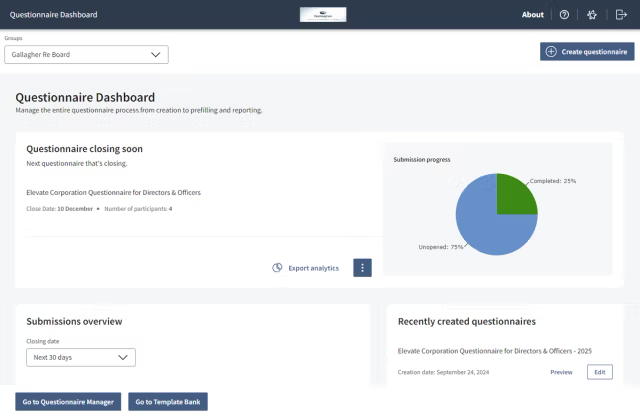
Smart Builder, a capability within Diligent Boards, automatically compiles evaluation results across individual director responses, peer assessments and committee evaluations into comprehensive analytical reports. This eliminates manual data consolidation that historically consumes weeks of administrative effort per evaluation cycle.
Additionally, Diligent’s board assessment tool saves templates and results across successive years, reducing preparation time for board secretaries. The platform automatically tracks submissions and completions, enabling administrators to create customized analytical reports with just a few clicks, while virtually eliminating human error risks.
Beyond report generation, AI-powered analytics surface patterns and trends that manual review often misses, such as declining engagement on specific governance dimensions or persistent skills gaps across evaluation cycles.
This longitudinal intelligence helps boards move from reactive problem-solving to proactive governance improvement, turning annual assessments into a strategic advantage rather than a compliance exercise.
Because Diligent connects board evaluations with board portals, entity management and ESG data, organizations can turn evaluation findings into concrete governance improvements rather than static reports.
Board evaluations don’t have to be challenging or time-consuming. By implementing the 15 best practices outlined in this guide, organizations at every growth stage can establish evaluation disciplines that generate actionable governance insights while respecting director time constraints.
The systematic approach to evaluation design, automation and follow-up creates governance foundations that support scaling operations and investor confidence. When combined with best-in-class governance tools like Diligent, these practices help you scale through traditional assessment challenges.
By combining disciplined evaluation design with AI-powered analysis, boards can move from check-the-box surveys to continuously improving, data-driven governance.
Ready to streamline your board evaluation processes? Schedule a demo to see how Diligent can transform your assessment efficiency and governance insights.
A board self evaluation is a structured process in which the board assesses its own effectiveness, composition and governance practices. It can be conducted at the full board, committee or individual director level using questionnaires, facilitated discussions or third-party interviews. The goal is to identify strengths, surface improvement areas and create an action plan that strengthens governance over time.
Annual evaluations prevent major governance issues from developing while maintaining continuous improvement momentum. Regular assessments enable boards to identify and address challenges proactively, support director development and demonstrate accountability to stakeholders. They also help organizations prepare for funding rounds, transactions and regulatory scrutiny by documenting governance effectiveness.
AI technology automates data compilation and analysis, identifying patterns and trends that manual processes might miss. Tools like Diligent’s Smart Builder synthesize evaluation responses into professional reports with intelligent insights, while AI-powered analytics detect shifts in board sentiment across years and benchmark performance against industry peers and highlight specific improvement opportunities.
Equally important, automation reduces friction for both corporate secretaries and directors, making it more likely that evaluations happen on time and produce thoughtful responses.
Professional governance platforms like Diligent provide enterprise-grade security, including ISO 27001 certification, encrypted data transmission and storage and optional biometric authentication where supported. These platforms ensure complete anonymity while maintaining audit trails for compliance. Avoid generic survey tools that may lack adequate security and confidentiality controls for board-level communications.
Yes, sophisticated evaluation platforms provide benchmarking capabilities that compare governance practices and performance metrics against industry peers and best practice standards. This enables boards to understand their relative governance maturity and prioritize improvement initiatives based on data-driven insights rather than subjective assessments. By aggregating anonymized governance data, platforms like Diligent can show how your board’s practices compare to similar organizations on key dimensions such as risk oversight, composition and ESG.
Ready to transform your board governance? Schedule a demo to see Diligent in action.